Hong Kong—The Church in Asia is charting a course through the rapidly evolving digital landscape, with the Federation of Asian Bishops’ Conferences (FABC) Office of Social Communication (OSC) concluding a pivotal meeting in Hong Kong. The three-day gathering culminated in a unified call for the Church to respond with wisdom and pastoral discernment to the rise of Artificial Intelligence (AI), a technology that presents both immense promise and profound peril for the continent.
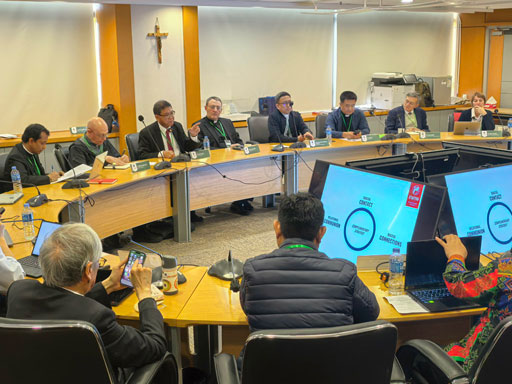
The 30th FABC-OSC Bishops’ Meet, held from December 10–12 at St. Francis University, brought together over 30 bishops, priests, religious, and lay media professionals from across the region. The FABC-OSC, established in 1974, is dedicated to bringing a Christian dimension to all communication activities within the Asian Catholic community, making this meeting a crucial moment for the Church’s mission in the digital age.
Bishop Marcelino Antonio M. Maralit Jr., chairman of FABC-OSC, presided over the closing Mass, urging participants to carry the fruits of their reflection back to their ministries. He stressed the necessity for the Church to remain present and discerning amid the swift technological shifts that are reshaping cultures, relationships, and pastoral life across Asia.
The Statement: Hope and Caution in the Age of Algorithms
The participants released a comprehensive statement, the fruit of “prayer, discernment, and dialogue,” on the theme “Artificial Intelligence and Pastoral Challenges in Asia.” The document presents a balanced view, embracing the potential of AI while issuing a strong caution against its inherent risks when misused.
AI Not to Be Feared but Discerned: Church Reaffirms Mission Rooted in Human Relationships
The statement begins by reaffirming the Church’s unchanging mission: to proclaim Christ, uphold human dignity, and foster authentic communion. AI, an expression of human creativity, is not to be feared, but engaged with prudence and an incarnational vision rooted in human relationships.
The bishops grounded their conviction in the words of Pope Francis, who, in his landmark 2024 Address to the G7 Session on Artificial Intelligence in Bari, Italy, reminded the world that AI is “above all a tool,” whose ethical value depends entirely on its human creators and users . The FABC-OSC noted that in Asia’s diverse religious and cultural landscape, this calls the Church to ensure that AI serves fraternity, justice, and the relational harmony integral to Asian traditions.
Opportunities for Evangelization
The assembly recognized that well-guided AI can be a powerful ally in the Church’s mission. It can support evangelization, pastoral care, catechesis, and education by broadening access to knowledge and enhancing the Church’s digital presence. They specifically noted that AI can bridge rural digital divides, support minority Christian communities, and foster intergenerational wisdom.
Citing “Pope Leo XIV,” the statement described AI as a “participation in the divine act of creation,” calling for systems that advance Catholic education, compassionate healthcare, and evangelization through a “dialogue between faith and reason” (Antiqua et Nova, 83).
Concerns and the Erosion of the Human Face
Despite the opportunities, the bishops expressed serious concerns about the emerging risks, which they fear could weaken the very fabric of human and spiritual life. These include:
•Illusions of Intimacy: The risk of simulated presence and “fake intimacy” with artificial personas.
•Erosion of Truth: The proliferation of deep fakes and biased content in the digital environment.
•Diminished Relationships: Excessive reliance on machines risks weakening genuine human relationships, diminishing prayer and reflection, and reducing the irreplaceable presence of teachers, pastors, and parents.
The bishops expressed particular unease about AI-generated religious content that may distort doctrine or manipulate sacred realities. They echoed “Pope Leo XIV’s” stress that AI cannot replicate moral discernment or genuine relationships, and may deepen inequalities through discriminatory algorithms.
Theological and Anthropological Foundations
The core of the FABC-OSC’s reflection lies in a profound theological distinction: intelligence itself is never artificial; only machines are. Human beings, endowed with spiritual, moral, emotional, and relational depth, cannot be reduced to algorithms. This distinction compels the Church to ask anew: What does it mean to be human?
The statement affirmed the God-given dignity of each person, whose worth cannot be captured by data or computation. God’s communication is incarnational, rooted in presence, encounter, and community. Technology must never replace genuine human engagement or blur the line between reality and simulation. The Church must therefore guard truth, protect the human face, and preserve spaces for contemplation and authentic relationships.
Practical Commitments for the Church in Asia
The meeting concluded with a list of practical commitments to guide the Church’s engagement with AI:
| Area of Commitment | Proposed Action |
| Innovation & Resources | Develop Catholic AI tools grounded in Scripture and Asian cultural contexts; Digitize Church resources for accurate use in AI systems. |
| Formation & Education | Integrate AI literacy with pastoral, ethical, and relational formation in seminaries, schools, and families. |
| Pastoral Presence | Promote digital evangelization marked by human oversight and pastoral accountability. |
| Policy & Collaboration | Engage in public policy and foster regional collaboration through FABC-OSC to craft contextual guidelines. |
The Bishops’ Meet affirms that AI is neither an existential threat nor a ready-made solution, but a new pastoral frontier calling for wisdom, vigilance, and hope. As the meeting coincided with the Feast of Our Lady of Guadalupe, the bishops concluded with a Marian reflection, praying that Mary, who spoke to Juan Diego in his own language, will strengthen the Church in Asia to speak to the “natives of this new digital world, in their language of AI,” promoting faith, authentic communion, and genuine human relationships .
A Marian and Sacramental Reflection on the Feast of Our Lady of Guadalupe
As the meeting providentially coincided with the Feast of Our Lady of Guadalupe, the bishops concluded their statement with a Marian reflection deeply rooted in the sacramental life of the Catholic Church. They recalled how the Blessed Virgin Mary, in her apparition to Saint Juan Diego on December 12, spoke in his own language and appeared clothed in symbols familiar to his people. Through this gentle inculturation, Mary led countless hearts not merely to belief, but to conversion—drawing them into the life of grace through Confession, Eucharistic worship, and attentive listening to Sacred Scripture.
In Mary’s example, the Catholic Church is reminded that true evangelization always leads the faithful to the altar. Her maternal pedagogy invites souls to reconciliation through the Sacrament of Penance, to silent surrender before her Son in Eucharistic Adoration, to persevering trust through the praying of the Rosary daily, and to full participation in the Holy Mass where Christ offers Himself for the life of the world.
Through the intercession of Our Lady of Guadalupe, the bishops expressed their hope that the Church in Asia may be strengthened to proclaim Christ within the emerging digital culture, speaking to the inhabitants of this new digital world with clarity, humility, and love. Rooted firmly in the Catholic church teachings and nourished by the sacraments, the Catholic Church is called to engage even the language of artificial intelligence in a way that draws persons back to communion—with God, with one another, and with the living Word who alone gives life.