St Carlo Acutis relic travels across Australia on Eucharistic mission
A major relic of St Carlo Acutis is travelling from bustling cities to country towns on a four-month mission intended to draw Australians closer to Christ in the Eucharist.
The St Carlo Acutis relic will visit 19 dioceses and more than 50 cities and towns during its Australian mission.
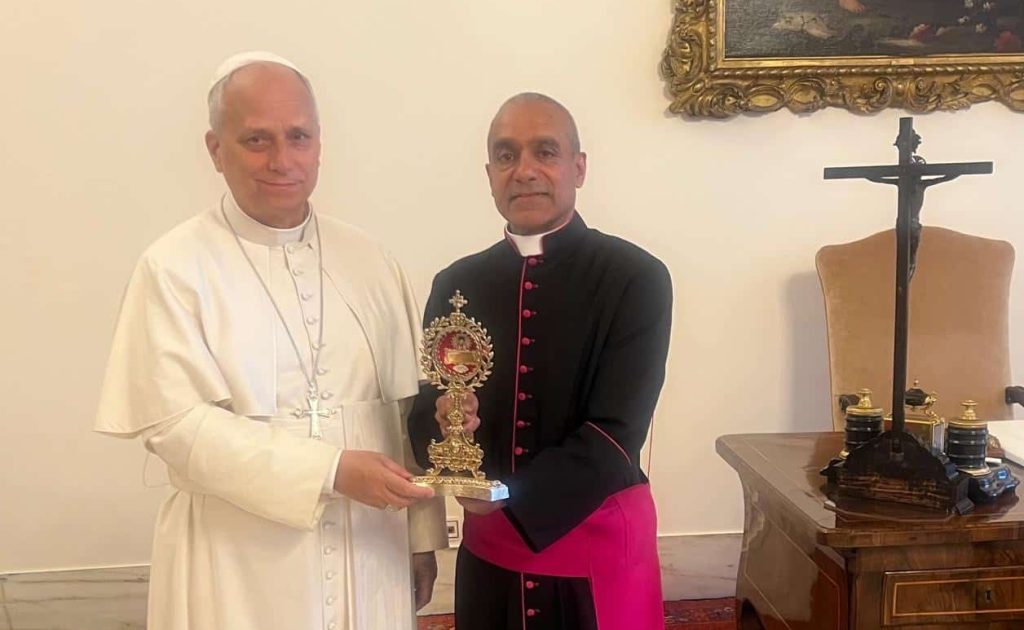
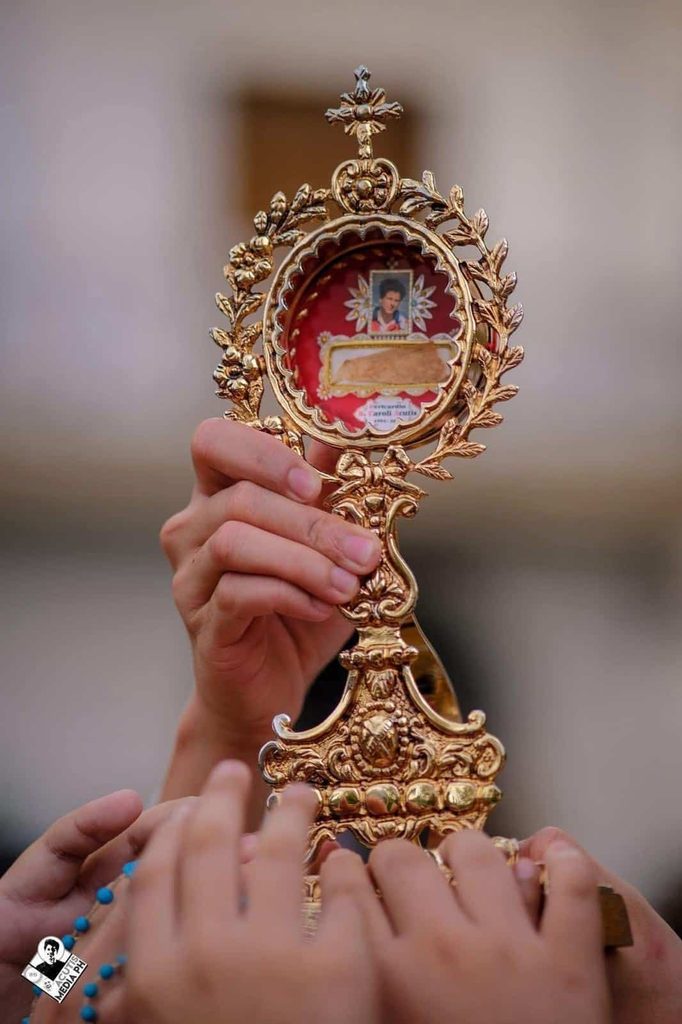
Australia is the 25th nation to receive the first-class major pilgrim relic, which contains a section of the saint’s pericardium — the sac surrounding the heart.
The mission began at St Mary’s Cathedral on 25 June and will visit 19 dioceses and more than 50 cities and towns before concluding in Sydney on 25 October.
The relic is travelling with Friends of St Carlo Acutis Australia and its custodian, Msgr Anthony Figueiredo, who coordinates the international relic missions from Assisi.
Citing GK Chesterton’s observation that “each generation is converted by the saint who contradicts it most”, Msgr Figueiredo said Carlo challenged the preoccupations of the present age by pointing people back to Christ.
“Carlo is certainly one of those saints; he points to Jesus in the Eucharist,” he told The Catholic Weekly.
The mission comes as Sydney prepares to host the 2028 International Eucharistic Congress, which Pope Leo XIV has indicated he will attend.
“This is like an appetiser to open hearts,” Msgr Figueiredo said. “That’s why we bring the pericardium relic — because it’s a heart-to-heart encounter.”
The mission has extended beyond churches, taking the relic to prisons, aged-care homes, schools, the sick and street missions. Young people have responded particularly strongly to the example of a saint who died from leukaemia in 2006, aged just 15.
“Kids are really fascinated by a kid who’s just like them,” Msgr Figueiredo said.
“They look at Carlo and say, ‘He’s just like me,’ and they say, ‘I can be Carlo.’”
Kate Hobbs, president of Friends of St Carlo Acutis Australia, said the mission had developed in unexpected ways.
“Carlo goes where Carlo wants,” she said.
“Carlo taps people on the shoulder and becomes their friend before they know he’s their friend.
“Even when I one day thought, ‘I’m inspired to get the relic,’ I’m sure that was Carlo.”
Hobbs said Carlo’s canonisation presented his life as a path to holiness that could be followed by people throughout the world.
“Every age, God raises a big saint,” she said. “I believe Carlo is the big saint for our age.”
“God is really saying, ‘That’s where the church should be heading.’”
Jessica, a mission volunteer whose surname has been withheld for privacy, said she had found joy in speaking about the Eucharist to people unfamiliar with the faith.
She was particularly moved during a visit to a Western Australian school, when its priest chaplain was invited to lift the reliquary and bless the students individually.
“I was moved to tears because I could feel how much he loved every one of those kids and desired for them to know Jesus,” she said.
“He especially wanted to give them Carlo as an example and then bless them with his relic.”
Msgr Figueiredo said encounters with the relic had also prompted priests to rediscover the heart of their vocation.
“This is something we discover wherever we bring the relic: many priests need a renewal of their own priesthood,” he said.
“With the busyness of priesthood, the challenges, the crises and the loneliness, many of us draw away from what is so basic.
“Carlo enables us to reach again to our first love, who is Jesus – Jesus present in the Eucharist.”
The nationwide mission, Msgr Figueiredo added, was “not an end in itself”.
“In fact, it’s just a beginning.”
This article was first published by Catholic Weekly and has been adapted and republished by EWTN Australia.