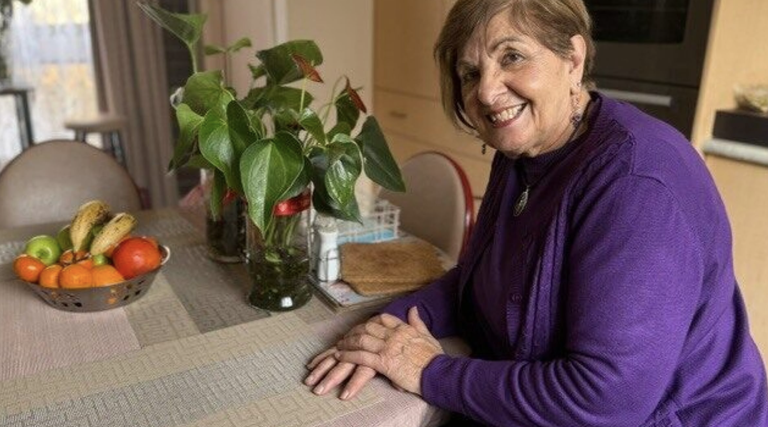
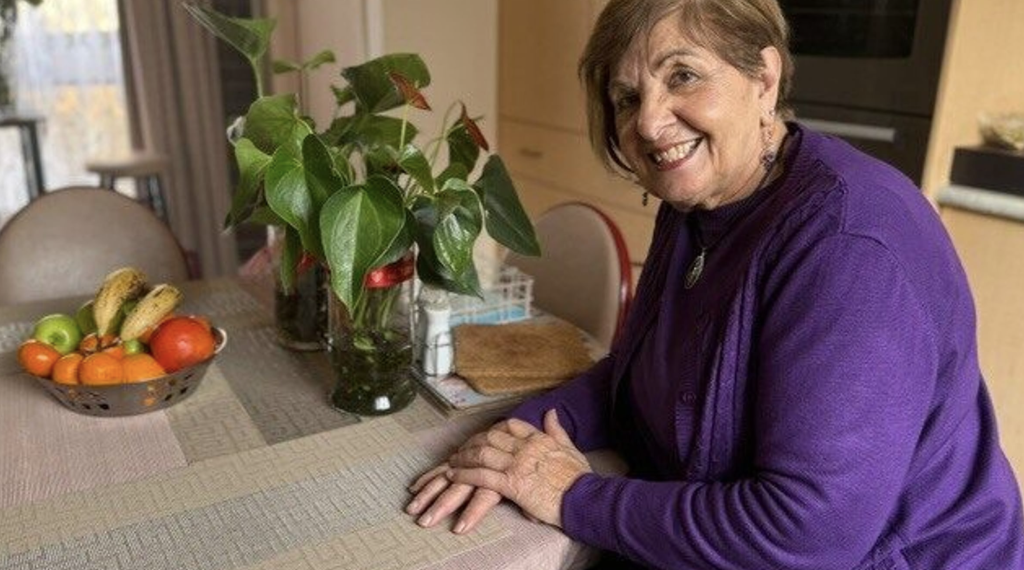
When Gabrielle Fakhry OAM talks about her work with refugees and asylum seekers, she tells stories about people. And there are many stories: the time she followed a prime minister around Coburg, slipping letters into his pocket; the fruiterer who arrived with a truckload of food just when the community lunch pantry was empty; the Muslim woman who volunteered to dress as Santa Claus.
They are funny and sometimes chaotic. They are also moving, like the one about the traumatised refugee grandfather who sat vigilantly outside a childcare centre because he was terrified someone would take his grandchildren. Together, they reveal a confident woman without a shred of ego, whose Catholic faith is expressed through practical love.
Gabrielle was born in New Zealand to a Kiwi dad and Lebanese mum, and she came to Australia as a young woman with her Lebanese Maronite husband, Tony.
Her significant work with refugees was recognised this year in the King’s Birthday awards, but began in 1981, when she supported Lebanese people arriving in Australia after the war in Lebanon. Having learnt the language herself as an adult, she was one of very few Arabic-speaking workers available to meet them.
“Everywhere I go, you’re putting letters in my pocket.”
Gabrielle Fakhry OAM and a life of service
While working for VICSEG—the Victorian Cooperative of Children’s Services for Ethnic Groups—Gabrielle helped establish a bilingual childcare centre with the Maronite Antonine Sisters in Coburg, an initiative that required years of persistence. In those days, she says, people did not understand the importance of maintaining language and culture, and a bilingual childcare centre was not high on the list of anyone’s priorities.
Fortuitously, the then-prime minister, Bob Hawke, was Gabrielle’s local MP. ‘So I was very cheeky. I would follow him to every meeting and put a letter in his pocket. I would write letters describing the nuns.
‘In the end, he said “Who the hell are you? Everywhere I go, you’re putting letters in my pocket,”’ she remembers.
After much lobbying, the project received funding. The childcare centre was built on land purchased by the sisters and, decades later, is still operating. Gabrielle remained involved with the Antonine Sisters for many years as they developed schools, aged care services and other community facilities.
Amid all this, Gabrielle and Tony were raising their family—three sons. Their eldest lives with a number of disabilities, and Gabrielle spends a great deal of time advocating for him with service providers. She also helps care for her nonagenarian mother, the matriarch of a large, close-knit family.
Supporting refugees and asylum seekers
As part of her work with VICSEG, she joined up with Darebin Council in 1999 to help asylum seekers leaving detention. ‘They’d come out with no clothes, no food, no money from the government, and it was just absolutely shocking,’ she says.
She began collecting clothing and food, and donations soon took over the prayer room shared by Muslim and Christian staff at VICSEG. Realising this was not ideal, Gabrielle asked to use a community centre in Thornbury owned by the B’charry Association, of which her husband was president.
A chance meeting with Kon Karapanagiotidis, who ran the Asylum Seeker Resource Centre in Footscray, led to the creation of a northern suburbs branch, the Thornbury Asylum Seekers Resource Centre. Volunteers offered classes, legal assistance, household goods and food.
“We’d have 30-40 people, and that pot never emptied.”
Building community through practical love
‘We ended up doing a community garden so people could grow their own vegetables,’ Gabrielle says. ‘We had English classes. I got funding and did a Saturday morning playgroup for traumatised children, with professional teachers coming and working with the children, which was amazing.’
The work was supported by churches, local organisations and people who simply wanted to help. Gabrielle remembers community lunches at which dozens of people might arrive, regardless of how little food seemed to be available.
One Saturday, the food bank was almost empty. There were a few onions and not much else, she recalls. Then, just as Gabrielle was preparing to go home and raid her own kitchen for something to cook, a fruiterer arrived with a truck full of fruit and vegetables.
‘I used to say it’s like the loaves and fishes,’ she says. ‘We’d have 30-40 people, and that pot never emptied. My volunteers, they used to say to me, “Gabrielle’s the miracle worker.”’
Gabrielle Fakhry OAM and her Catholic faith
Gabrielle sees these moments through the eyes of her Catholic faith. She is committed to both the Maronite and Roman rites. ‘Faith is a big part of our lives,’ she says. ‘We never miss church. Never.’
She and her mother pray the Rosary together each morning. Gabrielle also prays a litany of saints: St Charbel, St Joseph, St Mary of the Cross, St Teresa of Calcutta, St Francis of Assisi, St Rafka and St Maron.
Her faith makes her curious about other religions. With much of her work involving Muslim communities, Gabrielle studied Islam to help her understand the people she was serving. She also worked with the Australian Muslim Women’s Centre for Human Rights, training police and government workers on issues including domestic violence, early marriage and Islamic communities.
‘I have a lot of respect for all the religions,’ she says, struck by the many similarities between Islam, Judaism and Christianity. ‘There’s a lot of great things in all the religions, and there’s a lot of not-so-great things in each religion.’
A commitment to interfaith understanding
Her interfaith instincts also appeared during the first Christmas celebration at the asylum seeker centre. The children were invited to receive brand-new toys donated by a Uniting Church. Gabrielle hesitated about introducing Father Christmas because the children were Muslim.
The families quickly corrected her. ‘Who said we don’t believe in Christmas, Gabrielle?’ one woman asked. A Palestinian Muslim woman volunteered to be Santa and the celebration went ahead with great joy.
Gabrielle’s work has often involved responding to very immediate needs. When a Chilean refugee family needed a suit for their son’s First Communion, she found one of her own sons’ suits at home and bought the rest of the clothing.
‘She burst out crying,’ Gabrielle recalls, struck by how important such a seemingly simple gesture was for that family. ‘It’s things like that, the little things, that matter.’
There were also moments when the effects of her work only became apparent years later. A 1980s schoolgirl whose parents had kept her home to work in the family milk bar tracked her down decades later to thank Gabrielle for persuading her parents to send her back to school. She had become a professor with a successful international career. ‘And she said to me, ‘I never forgot you.’’
“I hope I made a difference.”
A remarkable life of service
‘I hope I made a difference,’ Gabrielle says. ‘People say I did. But it doesn’t matter. Even if two or three people think that you’ve made a difference, it does. You’re not going to stop what you do.’
That is Gabrielle Fakhry’s life of service. She sees a need, finds people willing to help, prays about the matter and gets on with the work.
Her Order of Australia Medal recognises her service to migrants, refugees and multicultural communities. But Gabrielle is more comfortable talking about the people who cooked, interpreted, delivered furniture, donated food and stood beside her than about being honoured herself.
‘I didn’t like having all the accolades,’ she says. ‘You don’t serve people to get that.’
We spoke to Gabrielle Fakhry ahead of World Day of Migrants and Refugees, Sunday 27 September 2026. The Australian Catholic Migrant and Refugee Office has information and resources for community groups and parishes who want to mark the day.
When Gabrielle Fakhry OAM talks about her work with refugees and asylum seekers, she tells stories about people. And there are many stories: the time she followed a prime minister around Coburg, slipping letters into his pocket; the fruiterer who arrived with a truckload of food just when the community lunch pantry was empty; the Muslim woman who volunteered to dress as Santa Claus.
They are funny and sometimes chaotic. They are also moving, like the one about the traumatised refugee grandfather who sat vigilantly outside a childcare centre because he was terrified someone would take his grandchildren. Together, they reveal a confident woman without a shred of ego, whose Catholic faith is expressed through practical love.
Gabrielle was born in New Zealand to a Kiwi dad and Lebanese mum, and she came to Australia as a young woman with her Lebanese Maronite husband, Tony.
Her significant work with refugees was recognised this year in the King’s Birthday awards, but began in 1981, when she supported Lebanese people arriving in Australia after the war in Lebanon. Having learnt the language herself as an adult, she was one of very few Arabic-speaking workers available to meet them.
“Everywhere I go, you’re putting letters in my pocket.”
Gabrielle Fakhry OAM and a life of service
While working for VICSEG—the Victorian Cooperative of Children’s Services for Ethnic Groups—Gabrielle helped establish a bilingual childcare centre with the Maronite Antonine Sisters in Coburg, an initiative that required years of persistence. In those days, she says, people did not understand the importance of maintaining language and culture, and a bilingual childcare centre was not high on the list of anyone’s priorities.
Fortuitously, the then-prime minister, Bob Hawke, was Gabrielle’s local MP. ‘So I was very cheeky. I would follow him to every meeting and put a letter in his pocket. I would write letters describing the nuns.
‘In the end, he said “Who the hell are you? Everywhere I go, you’re putting letters in my pocket,”’ she remembers.
After much lobbying, the project received funding. The childcare centre was built on land purchased by the sisters and, decades later, is still operating. Gabrielle remained involved with the Antonine Sisters for many years as they developed schools, aged care services and other community facilities.
Amid all this, Gabrielle and Tony were raising their family—three sons. Their eldest lives with a number of disabilities, and Gabrielle spends a great deal of time advocating for him with service providers. She also helps care for her nonagenarian mother, the matriarch of a large, close-knit family.
Supporting refugees and asylum seekers
As part of her work with VICSEG, she joined up with Darebin Council in 1999 to help asylum seekers leaving detention. ‘They’d come out with no clothes, no food, no money from the government, and it was just absolutely shocking,’ she says.
She began collecting clothing and food, and donations soon took over the prayer room shared by Muslim and Christian staff at VICSEG. Realising this was not ideal, Gabrielle asked to use a community centre in Thornbury owned by the B’charry Association, of which her husband was president.
A chance meeting with Kon Karapanagiotidis, who ran the Asylum Seeker Resource Centre in Footscray, led to the creation of a northern suburbs branch, the Thornbury Asylum Seekers Resource Centre. Volunteers offered classes, legal assistance, household goods and food.
“We’d have 30-40 people, and that pot never emptied.”
Building community through practical love
‘We ended up doing a community garden so people could grow their own vegetables,’ Gabrielle says. ‘We had English classes. I got funding and did a Saturday morning playgroup for traumatised children, with professional teachers coming and working with the children, which was amazing.’
The work was supported by churches, local organisations and people who simply wanted to help. Gabrielle remembers community lunches at which dozens of people might arrive, regardless of how little food seemed to be available.
One Saturday, the food bank was almost empty. There were a few onions and not much else, she recalls. Then, just as Gabrielle was preparing to go home and raid her own kitchen for something to cook, a fruiterer arrived with a truck full of fruit and vegetables.
‘I used to say it’s like the loaves and fishes,’ she says. ‘We’d have 30-40 people, and that pot never emptied. My volunteers, they used to say to me, “Gabrielle’s the miracle worker.”’
Gabrielle Fakhry OAM and her Catholic faith
Gabrielle sees these moments through the eyes of her Catholic faith. She is committed to both the Maronite and Roman rites. ‘Faith is a big part of our lives,’ she says. ‘We never miss church. Never.’
She and her mother pray the Rosary together each morning. Gabrielle also prays a litany of saints: St Charbel, St Joseph, St Mary of the Cross, St Teresa of Calcutta, St Francis of Assisi, St Rafka and St Maron.
Her faith makes her curious about other religions. With much of her work involving Muslim communities, Gabrielle studied Islam to help her understand the people she was serving. She also worked with the Australian Muslim Women’s Centre for Human Rights, training police and government workers on issues including domestic violence, early marriage and Islamic communities.
‘I have a lot of respect for all the religions,’ she says, struck by the many similarities between Islam, Judaism and Christianity. ‘There’s a lot of great things in all the religions, and there’s a lot of not-so-great things in each religion.’
A commitment to interfaith understanding
Her interfaith instincts also appeared during the first Christmas celebration at the asylum seeker centre. The children were invited to receive brand-new toys donated by a Uniting Church. Gabrielle hesitated about introducing Father Christmas because the children were Muslim.
The families quickly corrected her. ‘Who said we don’t believe in Christmas, Gabrielle?’ one woman asked. A Palestinian Muslim woman volunteered to be Santa and the celebration went ahead with great joy.
Gabrielle’s work has often involved responding to very immediate needs. When a Chilean refugee family needed a suit for their son’s First Communion, she found one of her own sons’ suits at home and bought the rest of the clothing.
‘She burst out crying,’ Gabrielle recalls, struck by how important such a seemingly simple gesture was for that family. ‘It’s things like that, the little things, that matter.’
There were also moments when the effects of her work only became apparent years later. A 1980s schoolgirl whose parents had kept her home to work in the family milk bar tracked her down decades later to thank Gabrielle for persuading her parents to send her back to school. She had become a professor with a successful international career. ‘And she said to me, ‘I never forgot you.’’
“I hope I made a difference.”
A remarkable life of service
‘I hope I made a difference,’ Gabrielle says. ‘People say I did. But it doesn’t matter. Even if two or three people think that you’ve made a difference, it does. You’re not going to stop what you do.’
That is Gabrielle Fakhry’s life of service. She sees a need, finds people willing to help, prays about the matter and gets on with the work.
Her Order of Australia Medal recognises her service to migrants, refugees and multicultural communities. But Gabrielle is more comfortable talking about the people who cooked, interpreted, delivered furniture, donated food and stood beside her than about being honoured herself.
‘I didn’t like having all the accolades,’ she says. ‘You don’t serve people to get that.’
We spoke to Gabrielle Fakhry ahead of World Day of Migrants and Refugees, Sunday 27 September 2026. The Australian Catholic Migrant and Refugee Office has information and resources for community groups and parishes who want to mark the day.
This article was first published by Melbourne Catholic and has been adapted and republished by EWTN Australia.