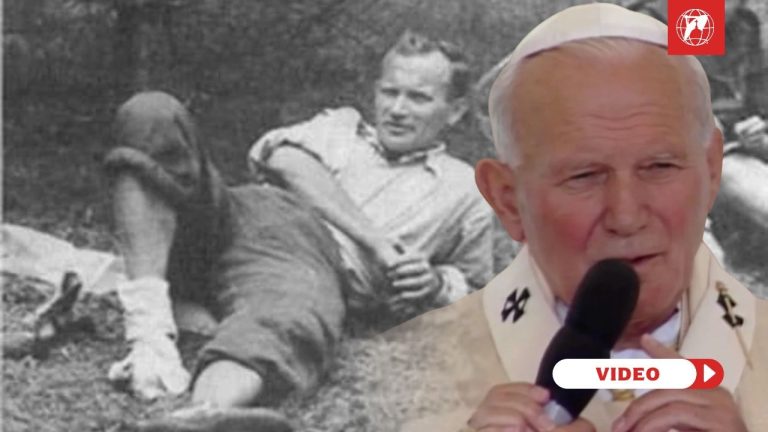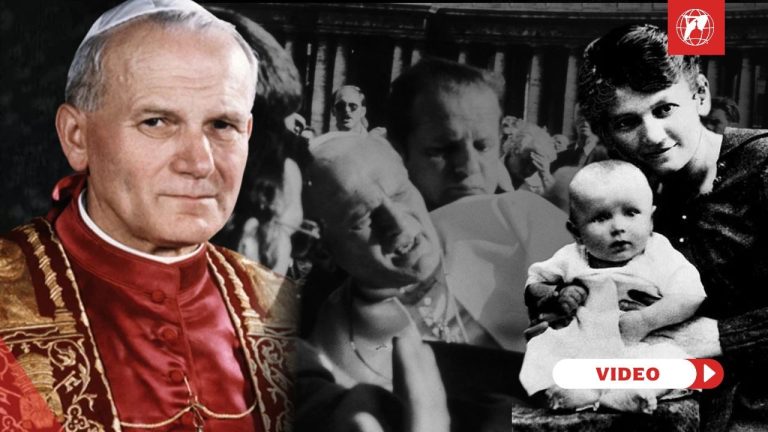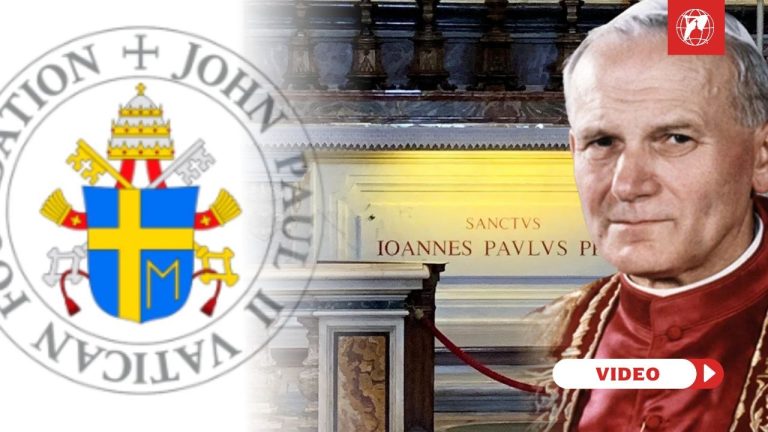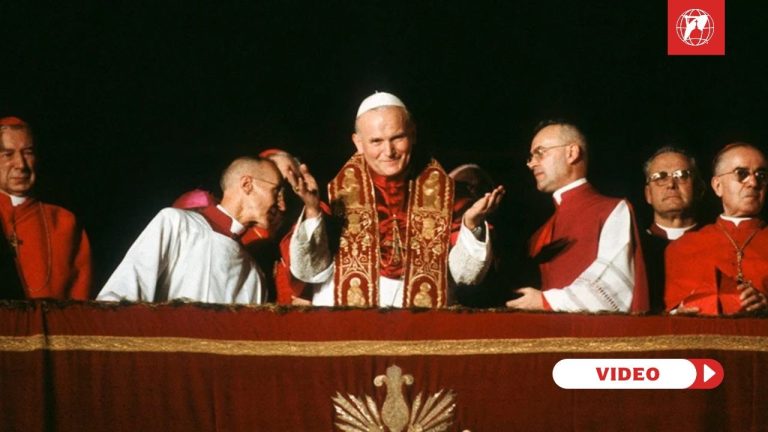
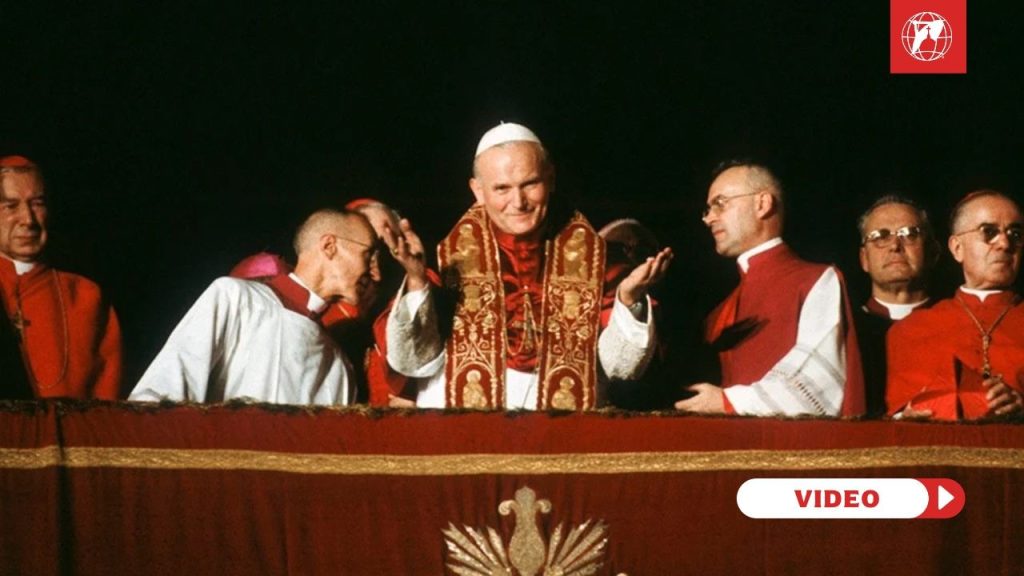
Forty-eight years after the election of Pope St. John Paul II, the Polish community in Rome continues to celebrate the life and legacy of the beloved pontiff, remembering his witness to faith, his commitment to peace, and his closeness to the sick and suffering.
Each year, Polish Catholics gather in the square where thousands celebrated the election of Karol Wojtyła as the 264th successor of St. Peter on Oct. 16, 1978. Through prayer, the Rosary, and reflections on the saint’s life, they give thanks for his pontificate and ask for his intercession.
Archbishop Janosz Urbańczyk, Apostolic Nuncio to Zimbabwe, recalled the moment he learned of Wojtyła’s election while he was still a young boy in Poland.
“I was still a young boy in Poland, but I remember the moment of the announcement, and it was something incredible. I couldn’t believe it,” he said.
For Urbańczyk, one of the defining aspects of John Paul II’s pontificate was his ability to bring people closer to God and invite them into a personal relationship with Jesus Christ.
“I think that indeed Pope was the one who was making the kind of introduction for the people of the closeness of God. This is his word being opened, opened widely the doors. It’s something that inviting people to enter into personal relationship with Jesus Christ. And this is something that was translated by him into personal life, life of prayer, life of concern for the people, life of concern for the world, for the situation,” the archbishop said.
He added that the pope’s influence continues to inspire the faithful today, even decades after his death.
“But I think that for the many, they recognize that this Pope was a gift of God, and we must recognize and be grateful to God for this gift and to understand and to live this as something that personally, to recognize that the Pope was the one who was inspiring through simple messages, but the one who was always close. And I think for the many people who are open to faith, the Pope is still the one who is behind the scenes, behind and helping us in our way of life, life of faith.”
John Paul II’s enduring message of peace
Peace was a central theme of the commemorative prayer vigil, reflecting a message that John Paul II consistently championed throughout his pontificate and that continues to resonate amid conflicts around the world.
For Urbańczyk, the gathering was an opportunity to renew the conviction that peace remains possible, even when the circumstances seem discouraging.
“As we were praying today, of peace is something that is possible. Unfortunately, it still is even today. I don’t know if we do believe that peace is possible in the world, in our families, in our situation of life. But it’s possible and we must believe. And this will be the gift of God for us, for us if we believe, if we are open to His presence in our life,” he said.
The Rosary was led by young Polish students living in Rome, who reflected on the saint’s legacy while finding a renewed sense of connection to their homeland and fellow countrymen.
For many, the annual gathering is more than a commemoration of a historical event. It is an opportunity to strengthen their faith and experience the solidarity of the Polish community while living abroad.
Oskar Podkowa, a student in Rome, described the importance of finding that sense of belonging after arriving in the Italian capital.
“It means a lot, like when I came here for the first time, It was really tough for me to settle and to find sort of like a grounding here and to just feel the community, the sense of community here, it’s really heartwarming,” he said.
“And I love how the Polish community here can create events like that and can get together. It’s really lovely.”
Klaudia Nowak, another Polish student, said that praying alongside fellow Poles makes the gathering especially meaningful.
“You know, you’re gathered and you get together with all the Poles, the whole community. I think it makes the ambience very strong and the prayer that we all gather together makes it stronger and more powerful. And honestly, these are the best moments, the best bits I carry on in my memory from my time here in Rome.”
A legacy that inspires a new generation
Although many of the young people attending the gathering never knew John Paul II during his pontificate, they say his example continues to shape their faith and understanding of the world.
Nowak said that hearing people from different countries speak positively about the Polish pope has strengthened her appreciation of his legacy.
“What is beautiful, once I moved here to Rome, is I’ve heard from people all over the world and from Romans speaking very positively about our Pope and not the Polish nation, it can only make us proud. And this opportunity to celebrate it in gatherings like this or other endeavors we do, I think that’s what makes carry the legacy even more,” she said.
For Podkowa, John Paul II’s message of peace is particularly important for younger generations.
“He said that peace can always be achieved and that we should always believe in that. And I believe that that’s a really good message and I believe we as a youth should also follow that and spread that,” he said.
Father Dariusz Giers, administrator of the John Paul II Vatican Foundation, also reflected on the pope’s lasting influence. Having spent 17 years working at the Pontifical Council for the Pastoral Care of Health Care Workers, he recalled John Paul II’s particular concern for those who were ill.
“What moved me the most? The Holy Father’s service to the sick. I saw the sick gathered here in the square at every audience, and the Holy Father would always go up to them. What touched me especially was when the Holy Father himself became ill. I was at one of his last audiences before his death, and it moved me deeply because by then he was practically confined to a wheelchair. He spoke very little and was no longer really able to speak. Yet that day he received more than 500 people, not only Poles, but people from all over the world,” Giers said.
He recalled how the pope continued to seek contact with people even as his health deteriorated, drawing strength from their presence and remaining committed to his pastoral mission until the end.
“The Holy Father lives through his closeness to people. He draws energy from them, from their visits, from being able to shake hands, embrace them, and from people being able to come close to him. That gives him a kind of life force, an energy, and he truly longs for it. What moved me deeply was that he gave himself completely to the very end.”
Giers also remembered the extraordinary silence that fell over St. Peter’s Square when John Paul II died on April 2, 2005.
“We could see that later as he was approaching death. I was here in the square when he passed away, and the silence that fell was extraordinary. You couldn’t even hear the fountains.”
Father Giers described John Paul II as a figure whose historical significance extended far beyond Poland. “He is the greatest Pole in history, and I have no doubt about that, because he made Poland known throughout the world,” he said.
Nearly five decades after his election, the Polish community’s annual gathering in Rome demonstrates how John Paul II’s legacy continues to unite generations. Through prayer, his witness to the sick, his call to peace, and his invitation to a personal relationship with Christ, the saint remains a source of inspiration for Catholics in Rome and around the world.
Adapted by Jacob Stein. Produced by Bénédicte Cedergren; Camera by Fabio Gonnella.